


Cập nhật (Ngày 1 tháng 10 năm 2026): Bài viết này đã được cập nhật…
Claude at scale on Google Cloud: Frontier AI, built for enterprise production
Operating advanced Artificial Intelligence (AI) models in real-world production environments presents significant technical challenges for organizations. Businesses need to simultaneously address complex issues: managing high-speed server systems, maintaining low latency globally, controlling regional data sovereignty, and reliably handling extremely long contextual requests.
 To precisely meet these stringent requirements, a combination of the Claude model (from Anthropic) and Google Cloud infrastructure was created. In this collaboration, Claude acts as the "brain," providing superior reasoning capabilities, while Google Cloud offers comprehensively managed infrastructure, global reach, and an enterprise-grade security compliance platform.
This article will provide a detailed analysis of the core aspects that make deploying Claude on Google Cloud the optimal solution for large-scale businesses.
Managed infrastructure that frees engineering time
When operating Claude on Google Cloud, The system operates on a fully managed infrastructure. Businesses can focus resources on developing product features instead of setting up and maintaining complex server clusters. The platform automatically handles processes such as computing resource allocation, auto-scaling, load balancing, and failover.
Claude is currently available through Model Garden on Google's Agent Platform. The model is offered as a Service (Model-as-a-Service), supporting standard REST/JSON endpoints over HTTP/1.1 or HTTP/2. Operationally, calling Claude's API is completely identical to any other Google Cloud service, using the same Access Control Management (IAM), VPC Service Controls, and monitoring tools such as Cloud Logging and Cloud Monitoring.
Here's an example of Python code integrating Claude via the AnthropicVertex library:
client = AnthropicVertex(
project_id=”your-project-id”,
region=”us”
)
message = client.messages.create(
model=”claude-opus-4-8″,
max_tokens=1024,
messages=[{“role”: “user”, “content”: “Analyze this system architecture.”}]
)
This SDK will automatically handle authentication using the application's default login credentials and inherit the project's existing security configurations.
Global reach with consistent latency and built-in failover
Serving a worldwide user base from a single endpoint produces high tail latency and a single point of failure. Most enterprises can't replicate inference infrastructure across continents while keeping performance consistent.
Agent Platform exposes three endpoint types for Claude, each solving a different production requirement:
- Global endpoints route requests to a region with available AI compute capacity. For example, if us-central1 is capacity-constrained, traffic redirects to europe-west1 or another region with available capacity. That’s automatic failover and geographic load balancing without application-side routing logic. Global endpoints are ideal for maximum availability and lowest cost.
- Regional endpoints like us-east5 or europe-west1 keep prompts, completions, and intermediate state inside a specific geographical boundary, making it ideal for low latency and data-residency requirements.
- Multi-region endpoints give U.S. or EU data residency without single-region dependency. They dynamically route across regional endpoints providing built-in resilience against regional outages and capacity constraints.
The diagram below shows how applications reach Claude through these endpoint types, and how the Agent Platform serving layer routes traffic to the Compute AI clusters across regions:
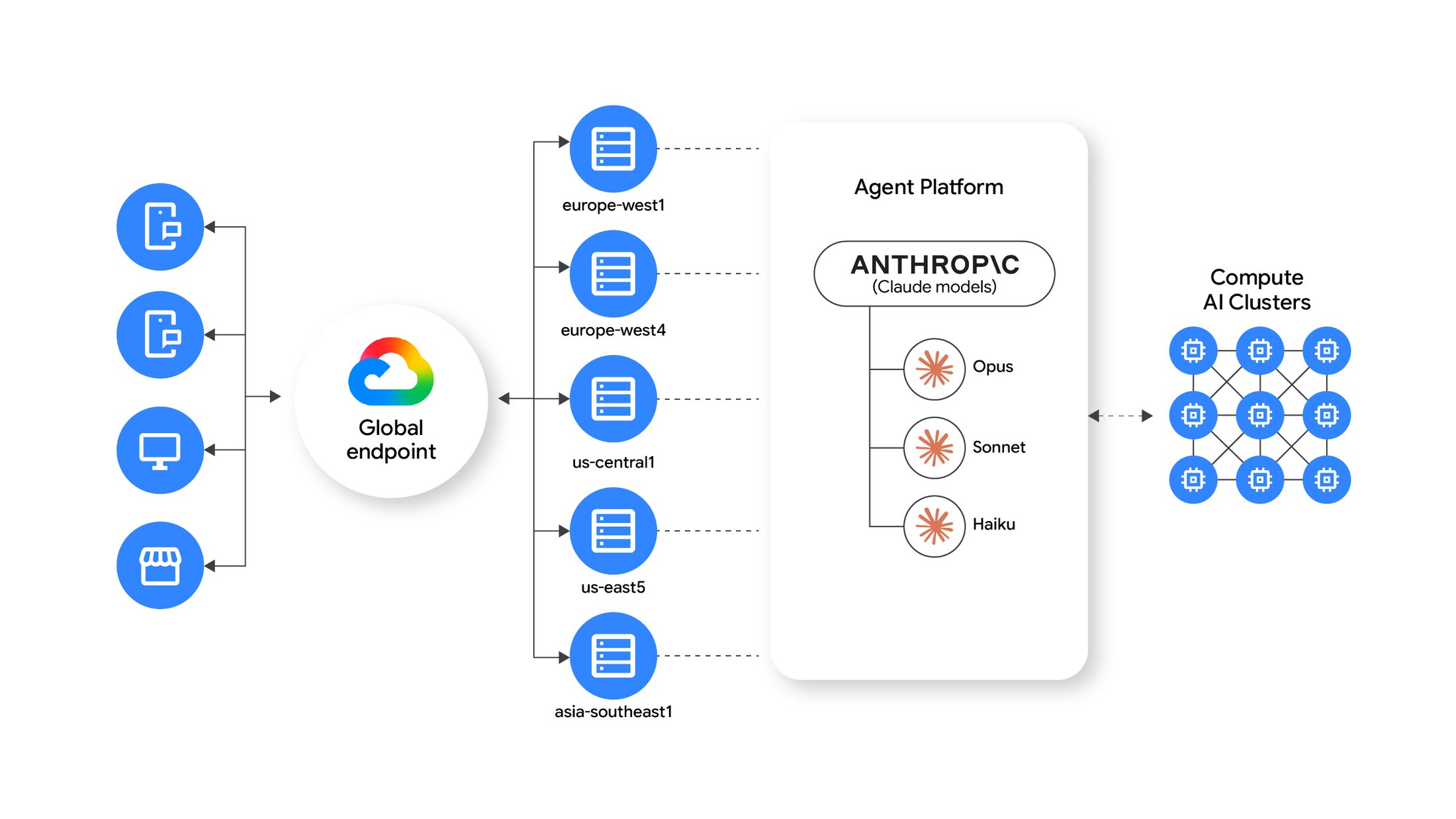 Serving Claude Models From Regional & Global Endpoints
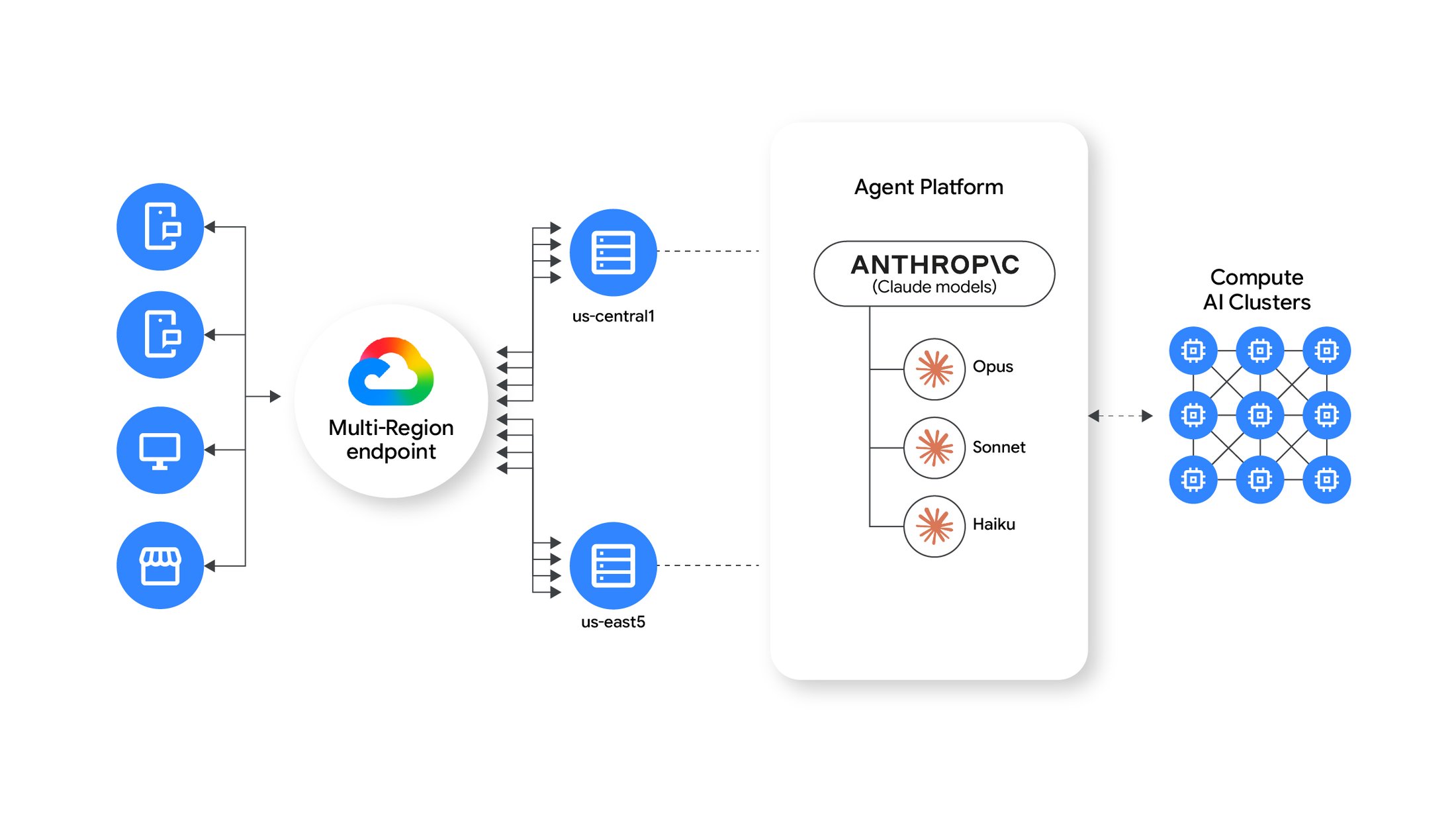 Serving Claude Models From Multi-Region Endpoints
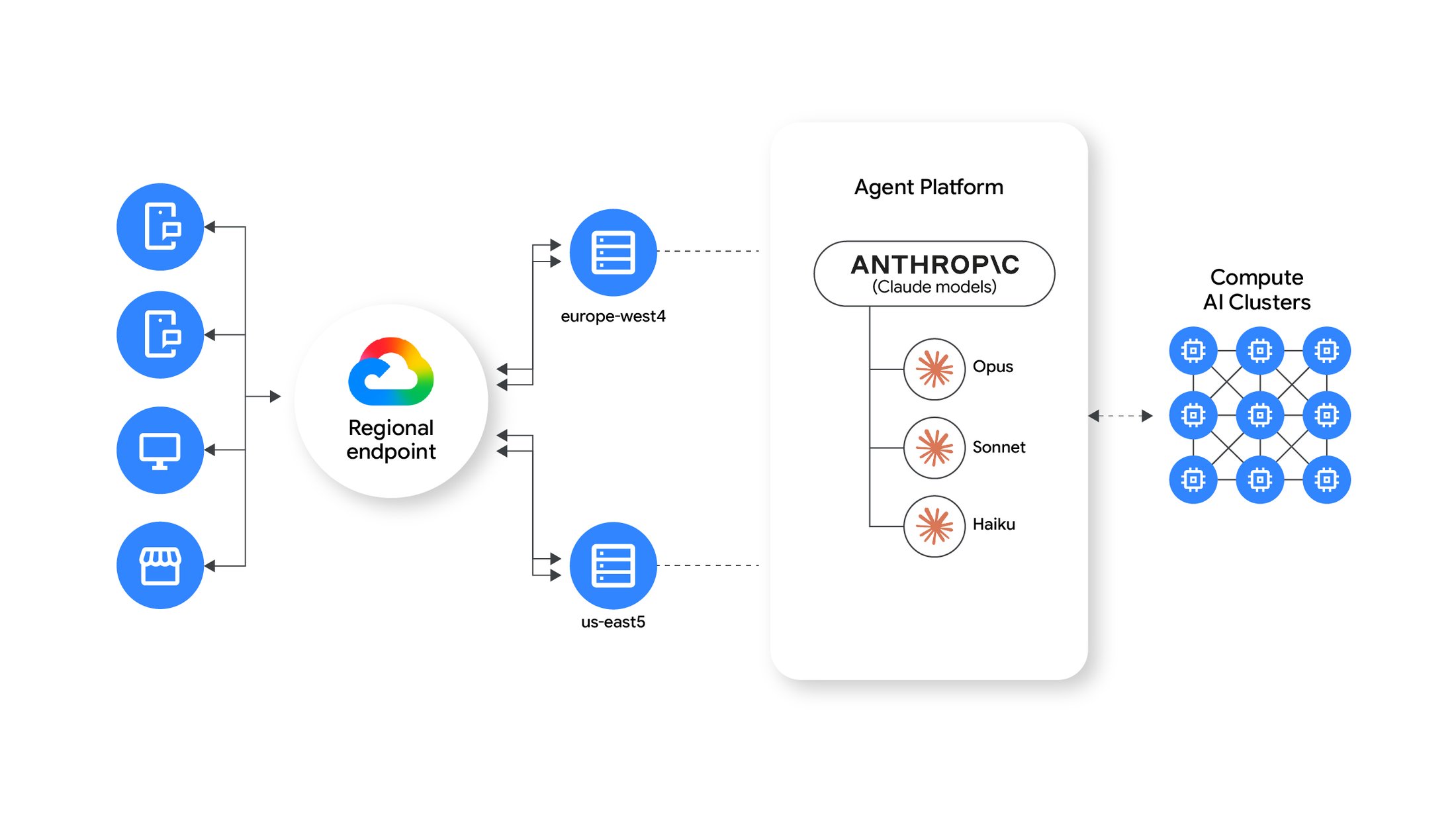 Serving Claude Models From Regional Endpoints
Enterprise security and data sovereignty built in
For industries with stringent management requirements such as finance, healthcare, and government, Claude on Google Cloud provides complete peace of mind by inheriting the entire GCP security framework.
- Comply with international standards: The platform meets stringent standards such as FedRAMP High and HIPAA.
- Data control: The VPC Service Controls feature allows you to establish secure boundaries around AI resources, effectively preventing data leakage.
- Identity management: Direct integration with Google Cloud IAM allows administrators to grant granular access permissions without having to manage or modify individual API keys.
Optimized for cost and performance at scale
In production, cost and performance drive every architectural decision. Getting both right requires capabilities from two layers: Claude's native model features, and Google Cloud's serving infrastructure. Agent Platform supports both, so teams can optimize across the stack without managing them separately.
Claude-native capabilities, fully supported on Agent Platform
These features are built into Claude and available on Agent Platform without any additional configuration:
- Prompt caching stores and reuses shared prefixes — long system prompts, legal documents, codebases — reducing request latency by up to 80% and cost by up to 90%.
Streaming responses over server-sent events deliver tokens as they are generated, critical for chat interfaces and coding assistants where perceived latency matters. - Extended and adaptive thinking lets Claude dynamically determine when and how much to reason through complex, multi-step problems — and allows users to dial the thinking effort directly, for example to control cost. Optimized for use cases like advanced code generation, mathematical reasoning, and multi-document analysis.
- Extended context windows up to 1M tokens (for Claude Opus 4.6,Sonnet 4.6 and newer models) enable long-document analysis, large codebase reasoning, and multi-turn conversations at depth.
Google Cloud serving infrastructure
Agent Platform adds its own serving-layer capabilities on top of Claude's native features:
- Batch prediction handles large-scale offline workloads — document classification, content moderation, bulk summarization — asynchronously at lower priority and reduced cost.
- Provisioned throughput reserves dedicated inference capacity for mission-critical workloads, isolating them from public traffic and ensuring predictable performance during peak demand.
- Memory management and scheduling for long-context requests is handled at the infrastructure layer,.
Together, these two layers give teams the full range of optimization levers — from model-level efficiency to infrastructure-level capacity control — on a single, unified platform.
From inference to agents
The same infrastructure that serves Claude inference powers the agent layer of Agent Platform on Google Cloud. The build-and-register flow has three steps:
- Build: Claude is well-suited as an orchestration backbone — its extended context window, native tool use, and adaptive thinking make it effective at planning multi-step tasks and delegating to sub-agents. Pick Claude Opus, Sonnet, or Haiku from the Model Garden, then build with the Agent Development Kit (ADK) — code-first in Python, Go, Java, or TypeScript — deploy to Agent Runtime, Cloud Run or Google Kubernetes Engine.
- Deployment: Depending on your use case, select Agent Runtime, Google Kubernetes Engine or GKE Agent Sandbox to run your deployed agents.
- Interoperate over A2A: The Agent2Agent protocol runs at 150+ organizations, letting a registered Claude-powered agent delegate tasks to agents from SaaS and other service providers.
Gimasys – Strategic partner for AI and Google Cloud deployment in Vietnam
Integrating large-scale linguistic AI models like Claude into enterprise production workflows requires a well-structured infrastructure and security architecture planning strategy.
International Management System Integration Co., Ltd (Gimasys) is proud to be a Premier Partner of Google Cloud in Vietnam. With a team of highly experienced technology engineers holding advanced certifications from Google, Gimasys is committed to supporting your organization on its digital transformation journey.
Gimasys' service ecosystem includes:
- AI Architecture Consulting: Assess the current state of the system and design the most optimal Claude/Vertex AI integration roadmap for each specific business process.
- Deployment & Security: We support configuring MLOps infrastructure, setting up VPC and IAM security boundaries, ensuring that enterprise data remains absolutely secure.
- Cost optimization (FinOps): Analyze and configure server systems, applying features like Batch Prediction and Prompt Caching to optimize monthly API operating costs.
Conclusion
Bringing the Claude model to the Google Cloud infrastructure has effectively overcome traditional technical barriers, providing businesses with a powerful, secure, and easily scalable AI platform.
To begin setting up a next-generation Artificial Intelligence system for your organization, contact \ Gimasys, for advice on deploying Claude into your production environment on a large scale.
Related Posts